The Thirty-One Kitchen Design Rules, Illustrated & Annotated
Index to Rules
Aisles
Clearance
Cooking Surface, Cook Stove, Range Top
Countertops
Dishwasher
Door
- ADA Guidelines for entry doors
- Dishwasher door interference
- Entry door width
- Interference with other objects
- Oven door interference
Electricity
Food Preparation
Kitchen Triangle
Landing Areas
Lighting
Microwave Ovens
Oven
Range Top
- (See Cooking Surface)
Recycling Container
Refrigerator
Seating
Sink
Storage
Trash Receptacle
Walkways
Waste Receptacle
- (See Trash Receptacle)
Work Aisles
- (See Aisles)
Work Centers
Starting in 1944 the University of Illinois conducted a number of studies of kitchen design and developed the fundamental design principles that are still very much in use. These days the National Kitchen & Bath Association updates and publishes these basic design standards.
A kitchen that follows all of these rules is almost guaranteed to be both functional and safe. See how many rules your existing kitchen violates for a better understanding of why it may seem awkward and hard to use.
While these guidelines are a good start, they do not substitute for competent kitchen design. Design encompasses these rules and much more. It's the "much more" part that gets novice designers in trouble.
A new kitchen is a major investment, and not something you are going to want to do over because the first design was not quite right. So, invest in a good design. It's money well spent.
Legend
Building Code Requirement: Refer to national building and access codes. Your local code authority may have modified or added to these national requirements.
Universal Design: Refer to NKBA recommendations for universal design.
ADA/ANSI Guidelines: Refer to Americans with Disabilities Act guidelines and recommendations published by the American National Standards Institute for universal design. These may or may not be mandated by local building codes, but are required in some federally subsidized housing.
Notes: Remarks by the publishers of the rule or standard.
Comments: Our own observations and clarifications. We use comments to introduce rules and guidelines from other sources as well as discuss our own experience with an application of these guidelines.
Other Rules and Guidelines
These are not the only kitchen design "rules".
Designers, carpenters, cabinetmakers, plumbers, and electricians have worked out some rules of thumb over many years that may not rise to the level of "standards", but represent accepted practice proven over time to be effective.
We have included these in notes and comments where applicable.
Methodology & Overview
The NKBA Kitchen & Bathroom Planning Guidelines with Access Standards is a collection of illustrations and planning suggestions to aid professionals in the safe and effective planning of kitchens and bathrooms.
These guidelines are excerpted from the National Kitchen & Bath Association Professional Resource Library Kitchen Planning and Bath Planning volumes.
Designers and those interested in becoming kitchen and bath design professionals benefit by studying the complete body of knowledge found in the NKBA Professional Resource Library.
These flexible, easy-to-understand guidelines were developed under the guidance of the NKBA by a committee of professionals. The committee completed in-depth historical reviews of planning guidelines dating back to 1920.
The guidelines published in its booklet reflect a composite of the historical review, current industry environment, anticipated future trends, consumer lifestyles, new research, new building codes, and current industry practices; as well as a Kitchen Storage Research Project conducted by Virginia Polytechnic Institute.
The Universal Design Guideline Access Standard is a relatively new addition to the guidelines. It defines the rules for kitchens intended for use by persons with less than full physical abilities.
Get an official copy of the consolidated Kitchen & Bathroom Planning Guidelines.
Rule 1 - Kitchen Entry Doors
Building Code Requirement: No national Code requirement. Check for local code requirements where you live.
Universal Design: The clear opening of a doorway should be at least 34 (864mm) inches. This would require a minimum 36" (914mm) or 3'-0" door.
ADA/ANSI Guidelines:
- Clear openings of doorways with swinging doors shall be measured between the face of door and stop, with the door open 90 degrees. (ANSI 404.2.3)
- When a passage exceeds 24" (610mm) in depth, the minimum clear opening increases to 36". (ANSI A117.1 404)
Comments:
- Standard U.S./Canadian single swinging door widths include 18", 24", 28", 30", 32", 34" and 36" doors. Any other width and any door wider than 36" is generally made as a custom door.
- A 34" (2-10) interior door was until a few years ago a special order custom door. However, since ADA guidelines were first published, these have become widely available.
- A 36" opening for a narrow passageway requires a 38" door to meet the requirements of ANSI A117.1 404. These are usually not available except as a custom door – so narrow passageways should be avoided where possible.
Rule 2 - Kitchen Door Interference
Guideline: No entry door should interfere with the safe operation of appliances, nor should appliance doors interfere with one another.
Building Code Requirement: No national Code requirement. Check for local code requirements where you live.
Universal Design: The door area should include clear floor space for maneuvering which varies according to the type of door and direction of approach. See ADA/ANSI Guidelines below.
ADA/ANSI Guidelines:
- For a standard hinged or swinging door, the clearance on the pull side of the door should be the door width plus 18" by 60". (ANSI A 117.1 404.2.3.1)
- The clearance on the push side of the door should be a rectangle the with of the door times 48" (1,219mm) (See illustration). (ANSI A 117.1 404.2.3.1)
Comments: Door interference can be subtle.
For example, we like to locate refrigerators and pantries at the edge of the kitchen so that snack-seekers can get what they want without crossing into the main, working part of the kitchen. However, there is a good risk that the door of a refrigerator located next to an entry door will block entry when the refrigerator door is open.
If cabinets are improperly spaced, the doors of two adjacent cabinets may strike each other. In kitchen remodels, working within an existing space, such problems may be unavoidable. But they should be avoided if possible.
Don't Miss These Useful Kitchen Planning Articles

- Pantry Perfect: the Can't Go Wrong Pantry Design Rules
- Mise-en-Place: Learning About Kitchen Design From Commercial Kitchens
- Budget Kitchen Remodeling: Guide for the Frugal Homeowner
- The Remodeling Design & Planning Process
- How to Measure Your Kitchen (And Other Rooms)
- The Ergonomic Kitchen
For even more in-depth home remodeling articles visit our Index to Articles.
Rule 3 – Distance Between Work Centers (Kitchen Triangle)
Universal Design: The kitchen guideline recommendation meets Universal Design Guideline standards.
Notes:
- A major appliance and its surrounding landing/work area form a work center. The distances between the three primary work centers (cooking surface, primary sink, and refrigerator) form a work triangle.
- When the kitchen plan includes more than three primary appliance/work centers, each additional travel distance to another appliance/work center should measure no less than 4' nor more than 9'.
- Each leg is measured from the center-front of the appliance/sink.
- No work triangle leg may intersect an island/peninsula or other obstacle by more than 12" (305mm).
Code Requirement: No national Code requirement. Check for local code requirements where you live.
Comments:
- The kitchen work triangle, first identified by Lillian Moller Gilbreth, has been a cornerstone of kitchen design for more than 100 years. For more information about this pioneer of kitchen ergonomics, including her portrayal in two major motion pictures, see Arts & Crafts Kitchens The Birth of the Modern Kitchen.
- The concept of a kitchen work triangle does not work with every possible kitchen configuration.
- For example, in a Pullman kitchen where the sink, cooking surface, and refrigerator are on one wall, no triangle of any kind is possible *but the distance rules – 4' minimum, 9' maximum – still apply). Nonetheless, for most kitchens, it remains a valuable gauge of how well a kitchen design is likely to function.
- Th 26' maximum length of the triangle is often supplemented with the maxim that the minimum length should not be less than 13'. We don't know where this guideline comes from and have found no authority for the maxim. If the minimum distance between work centers of 4' is adhered to, the minimum overall distance will be 12'.
Rule 4 - Separation of work centers
Code Requirement: No national Code requirement. Check for local code requirements where you live.
Universal Design: The kitchen guideline recommendation meets Universal Design Guideline standards.
Comment: By "properly recessed tall corner unit" the rule means a wall cabinet that extends down to the countertop or a wall cabinet with an appliance garage located below the cabinet extending to the countertop. While these are acceptable, they are still not the best design option and should be avoided where possible.
Rule 5 - Work Triangle Traffic
Code Requirement: No national Code requirement. Check for local code requirements where you live.
Universal Design: The kitchen guideline recommendation meets Universal Design Guideline standards.
Comments: This rule states the ideal standard for new kitchens..
But in a great many existing kitchens, the kitchen is also the walkway leading to the back door or basement. The major traffic pattern is straight through the heart of the kitchen work triangle.
Unless significant alterations are made to the structure of the house, there is usually little that can be done about it.
If possible, however, locate the sink and range or cooktop out of the traffic path. If the refrigerator is in or adjacent to the path, it does little harm.
For the width of walkways and aisles in walk-in pantries, see Pantry Perfect The "Can't Go Wrong" Pantry Design Rules.
Rule 6 - Work Aisle
Guideline: The width of a work aisle should be at least 42" (1,067mm) for one cook and at least 48" (1,219mm) for multiple cooks. Measure between the counter frontage, tall cabinets and/or appliances.
Code Requirement: No national Code requirement. Check for local code requirements where you live.
- A clear floor space of at least 30" (762mm) by 48" (1,219mm) should be provided at each kitchen appliance. Clear floor spaces can overlap. (ANSI A 117.1 305.3, 804.6.1)
- In a U-shaped kitchen, plan a minimum clearance of 60" (2,032mm) between opposing arms. (ANSI A117.1 804.2.2, 1003.12.1.2).
- Include a wheelchair turning space with a diameter of at least 60" (2,032mm), which can include knee* and toe* clearances. (ANSI A117.1 304.3.1).
- A wheelchair turning space could use a T-shaped clear space, which is a 60" (2,032mm) square with two 12" wide x 24" (305mm x 610mm) deep areas removed from the corners of the square.
- This leaves a minimum 36" (914mm) wide base and two 36" (914mm) wide arms. T-shaped wheelchair turning spaces can include knee and toe clearances. (ANSI A117.1 304.3.2).
Universal Design: The ADA/ANSI Guideline recommendation meets Universal Design recommendation. See Code References for specific applications.
- Knee clearance must be a minimum of 30" (762mm) wide (36" (914mm) to use as part of the T-turn) and maintain a 27" (686mm) clear space under the cabinet, counter, or sink for a depth of 8" (229mm). The next 3" (76mm) of depth may slope down to a height of 9" (229mm), with a clear space of at least 17" (432mm) extending beneath the element. (ANSI 306.3).
- Toe clearance space under a cabinet or appliance is between the floor and 9" (229.6mm) above the floor. Where toe clearance is required as part of clear floor space, the toe clearance should extend 17" (432mm) minimum beneath the element. (ANSI A117.1 306.2).
- We believe that measuring between "cabinet frontage" as suggested by the Guideline is incorrect. Base cabinets have countertops and in most kitchens, the countertops project beyond the cabinet front about 1".
- If measurements are taken from the cabinet front, the actual floor space between two banks of cabinets would be 2" less than the desired minimum.
- The measurements should be taken from the edge of the countertops, not the fronts of the cabinets.
- There is a great deal of confusion over the distinction between a walkway and a work aisle. A work aisle is where a person stands while working in the kitchen. A walkway is a passageway through the kitchen.
- A combination work aisle/walkway should be avoided, if possible.
- Especially in older kitchens, the work aisle and walkway may be combined and be used both for work and for traversing the kitchen. In such a case, the minimum width of the combined walkway/work aisle should be 48" (1,219mm) where possible.
- The aisles and walkways in a kitchen can be widened by reducing the depth of adjacent cabinets, but not below a minimum of 21" (533mm).
Rule 7 - Walkway
Code Requirement: No national Code requirement. Check for local code requirements where you live.
Universal Design: If two walkways are perpendicular to each other, one walkway should be at least 42" wide.
- There is a great deal of confusion over the distinction between a walkway and a work aisle. A work aisle is where a person stands while working in the kitchen. A walkway is a passageway through the kitchen.
- Especially in older kitchens, the work aisle and walkway may be combined and be used both for work and for traversing the kitchen. In such a case, the minimum width of the combined walkway/work aisle should be 48" (1,219mm), where possible.
- The aisles in the kitchen triangle can be widened by adjusting the depth of adjacent cabinets, but not below a minimum of 21" (533mm).
About Kitchen Cabinets
Cabinets, more than any other item, determine the style of a kitchen.
Appliances, fixtures, flooring, even proper lighting are important, but cabinets are the element that chiefly defines the kitchen's look and function.
Because they play such a large role in your kitchen's design, it pays to learn as much as possible about the range of cabinet options. This means looking beyond style - although the style is important - to structure, finishes, hardware, and accessories.
To learn all about kitchen cabinetry, go to Cabinet Basics, Part 1: An Introduction to Cabinets.
Rule 8 - Traffic Clearance at Seating
- Allow at least 36" (914mm) to edge past.
- Allow at least 44" (1,118mm) to walk past.
- Plan a minimum of 60" (1,524mm) to allow passage for a person in a wheelchair.
Code Requirement: No national Code requirement. Check for local code requirements where you live.
Universal Design: In a seating area where no traffic passes behind a seated diner, allow 36" (914mm) of clearance from the counter/table edge to any wall or other obstruction behind the seating area.
Comments:
- A 32" (813mm) clearance is seldom appropriate. It can only work in a seating area that has just one seat.
If there are two seats, however, then the user of the second seat will have to pass behind the user of the first seat to get to the second seat, and the 36" (914mm) clearance rule applies to allow the second person to edge past.
A 44" (1,118mm) clearance is better if space is available. - A seating area should never extend into a work aisle but may extend into a walk area if a minimum walk space of 44" (1,118mm) is provided. This allows a walker to pass behind the seated diners.
- A clearance of 44" 44" (1,118mm) is the absolute minimum for two people to walk past each other, 48" (1,219mm) is better.
- A 60" (1,524mm) clearance is the minimum required for wheelchair access, 64" (1,626mm) or even 66" (1,676.4mm) is preferred.
Rule 9 - Seating Space
- For 30" (762mm) high tables/counters, a minimum 18" (457mm) deep clear knee space for each seated diner.
- For 36" (914mm) high counters, a minimum 15" (381mm) deep clear knee space for each seated diner.
- For 42" (1,067mm) high counters, a minimum 12" (305mm) deep clear knee space for each seated diner.
- Kitchen seating areas should be 28" - 34" (711mm - 364mm) high x 30" - 36" (762mm - 914mm) wide x 19" (483mm) deep to better accommodate people of various sizes or those using a mobility aid.
- Recommended minimum size for a knee space at a table or counter is 36" wide x 27" high x 19" deep (914mm wide x 686mm high x 483mm deep).
- Measure knee space from the front edge of the table or counter.
- While a 24" (610mm) wide space for each diner is workable, it is not very comfortable. A 28-30" (711 - 762mm) wide space is better and should be considered the minimum where space is available.
Rule 10 - Cleanup and Prep Sink Placement
Code Requirement: No national Code requirement. Check for local code requirements where you live.
Universal Design: Plan knee spaces at the sink to allow for a seated user.
Recommended minimum size for a knee space is 36" wide x 27" high x 8" deep (914mm wide x 686mm high x 457mm deep), increasing to 17" (686mm) deep in the toe space, which extends 9" (229mm) from the floor.
Insulation (padding) for exposed pipes should be provided.
- The sink should be no more than 34" (864mm) high or adjustable between 29" (737mm) and 36" (914mm). (ANSI 117.1.1002.4.2).
- The sink bowl should be no more than 6 1/2" (165mm) deep (ANSI 117.1 1002.12.4.3).
- Exposed water supply and drain pipes under sinks should be insulated (padded) or otherwise configured to protect against contact. There should be no sharp or abrasive surfaces under sinks. (ANSI A117.1 606.6).
Comments: In a pullman kitchen in which the entire kitchen is placed against one wall, the sink should be located between the cooktop and refrigerator.
Rule 11 - Cleanup and Prep Sink Landing Area
Code Requirement: No national Code requirement. Check for local code requirements where you live.
Note A: If all of the countertop at the sink is not the same height, then plan a 24" (610mm) landing area on one side of the sink and 3" (76mm) of countertop frontage on the other side, both at the same height as the sink.
Note B: The 24" (610mm) of recommended landing area can be met by 3" (76mm) of countertop frontage from the edge of the sink to the inside corner of the countertop if more than 21" (533mm) of countertop frontage is available on the return. (See Illustration 11A, Note B.)
Note C: Landing area is measured as countertop frontage adjacent to a sink and/or an appliance. The countertop must be at least 16" (406mm) deep and must be 28" (711mm) to 45" (1,143mm) above the finished floor to qualify.
Universal Design:
Kitchen guideline recommendation meets Universal Design standards.
Comments: In Universal Design, it is not uncommon for the cabinet containing the sink to be lower than the adjacent cabinets. Hence the standard in Note A allows the landing area to be at a different level than the sink countertops as long as there is at least 24" (610mm) of same-level countertop space on one side of the sink.
On a Budget?

Staying on budget does not have to mean doing without either essentials or some very nice refinements. You just have to choose wisely and use common sense.
Learn how to plan a beautiful, functional kitchen that is at the same time affordable.
Find ideas that we have found work well based on over 40 years of kitchen remodeling experience at Kitchen Remodeling on the Cheap: Proven Ideas for Creating Your Dream Kitchen on a Budget.
Rule 12 - Food Preparation Work Area
Guideline: Include a section of continuous countertop at least 36" (914mm) wide x 24" deep (762mm wide x 619mm deep) immediately next to a sink for a primary preparation/work area.
Code Requirement: No national Code requirement. Check for local code requirements where you live.
Universal Design: A section of continuous countertop at least 30" (762mm) wide with a permanent or adaptable knee space should be included somewhere in the kitchen.
ADA/ANSI Guidelines: In a kitchen, there should be at least one 30" (762mm) wide section of counter, 34" (864mm) high maximum or adjustable from 29" to 36" (737mm to x914mm).
Cabinetry can be added under the work surface, provided it can be removed or altered without removal or replacement of the work surface, and provided the finished floor extends under the cabinet. (ANSI A 117.1 8.04.6.3, 1003.12.6.3)
Comments: There are very limited circumstances under which the countertop next to a sink should be less than 30" (762mm) wide. If the countertop is deeper than the standard 25" (635mm), the minimum width should, nonetheless, remain 30" (762mm).
As a practical matter, it is sometimes necessary to decrease the depth of the countertop (never to less than 21" (533mm)). If this is the case, increase the width of the countertop work area to 36" (914mm).
Rule 13 - Dishwasher Placement
Note A: Provide at least 21" (533mm) of standing space between the edge of the dishwasher and countertop frontage, appliances and/or cabinets, which are placed at a right angle to the dishwasher.
Note B: In a diagonal installation, the 21" (533mm) is measured from the center of the sink to the edge of the dishwasher door while in it full open position.
Code Requirement: No national Code requirement. Check for local code requirements where you live.
Universal Design: Raise dishwasher 6" – 12" when it can be planned with appropriate landing areas at the same height as the sink.
ADA/ANSI Guidelines: A clear floor space of at least 30" x 48" (782mm x 1,219mm) should be positioned adjacent to the dishwasher door.
The dishwasher door in the open position should not obstruct the clear floor space for the dishwasher or the sink. (ANSI A 117.1 804.6.3, 1003.12.6.3)
Comments: The modern dishwasher is an ergonomic disaster. It's much too hard to use. You have to bend, twist, and stoop almost continuously to load and unload it. You have to spend a lot of time opening and closing the top tray to reach the bottom tray.
The bottom-hinged door gets in the way of people moving around the kitchen and makes it much harder for mobility-impaired users to load and unload. It is not a very user-friendly appliance.
A of the solution is to raise the dishwasher off the floor so that the center of the appliance is about waist high in kitchens where it is possible, that's what we do. Unfortunately, it's rarely possible in a residential kitchen.
The new drawer-style dishwashers are a vast improvement in a number of areas.
They offer superior ergonomic access, independent operation for smaller loads, and flexible, space-saving installation, and should be considered as an option for any major kitchen renovation.
Rule 14 - Waste Receptacles
Code Requirement: No national Code requirement. Check for local code requirements where you live.
Universal Design: Kitchen guideline recommendation meets Universal Design Standard.
Comments: The best location for the trash and recycling bins in most kitchens is under the sink. This placement makes the best use of a cabinet space that is otherwise hard to use because of the piping and disposer.
If the bins cannot be located under the sink, they should be adjacent to the sink, not more than 30" (762mm) from the center of the sink to the center of the waste bin.
Rule 15 - Auxiliary Sink
Code Requirement: No national Code requirement. Check for local code requirements where you live.
Universal Design: Plan knee spaces at the sink to allow for a seated user. Recommended minimum size for a knee space is 36" wide x 27" high x 8" deep (914mm wide x 686mm high x 457mm deep), increasing to 17" (686mm) deep in the toe space, which extends 9" (229mm) from the floor. Insulation (padding) for exposed pipes should be provided.
- The sink should be no more than 34" (864mm) high or adjustable between 29" (737mm) and 36" (914mm). (ANSI 117.1.1002.4.2).
- The sink bowl should be no more than 6 1/2" (165mm) deep (ANSI 117.1 1002.12.4.3).
- Exposed water supply and drain pipes under sinks should be insulated (padded) or otherwise configured to protect against contact. There should be no sharp or abrasive surfaces under sinks. (ANSI A117.1 606.6).
Rule 16 - Refrigerator Landing Area
- 15" (381mm) of landing area on the handle side of the refrigerator, or
- 15" (381mm) of landing area on either side of a side-by-side refrigerator, or
- 15" (381mm) of landing area which is no more than 48" (1,219mm) across from the front of the refrigerator, or
- 15" (381mm) of landing area above or adjacent to any undercounter style refrigeration appliance.
Code Requirement: No national Code requirement. Check for local code requirements where you live.
Universal Design: See ADA/ANSI Guidelines.
ADA/ANSI Guidelines: A clear floor space of 30" x 48" (762mm x 1,219mm) should be positioned for a parallel approach to the refrigerator/freezer with the center-line of the clear floor space offset 24" (610mm) maximum from the center-line of the appliance. (ANSI A 117.1 804.6.6, 1003.12.6.6)
Comments: Because the doors on a side-by-side refrigerator are always in the way of loading from either side of the appliance, the usual and often the only choice for a landing zone is the countertop across from the refrigerator.
If this is not possible, start the landing zone at the edge of the door in its fully open position, then add a minimum of 15" (381mm) of clear countertop for the actual landing area.
A 15" (381mm) landing zone is the bare minimum, large enough to hold two standard 1/6 BBL brown paper grocery sacks (12" x 7"). If possible it should be at least 30 (762mm) inches.
Rule 17 - Cook Surface Landing Area
Note A: The 12" (305mm) and 15" (381mm) landing areas must be at the same height as the cooking surface.
Note B: For safety reasons, in an island or peninsula situation, the countertop should also extend a minimum of 9" (229mm behind the cooking surface if the counter height is the same as the surface-cooking appliance.
Note C: For an enclosed configuration, a reduction of clearances shall be in accordance with the appliance manufacturer's instructions or per local codes. (This may not provide adequate landing area.)
Code Requirement: No national Code requirement. Check for local code requirements where you live.
Universal Design: Lower the cooktop to 34" (356mm) maximum height and create a knee space beneath the appliance.
- When a forward-approach clear floor space is provided at the cooktop, it should provide knee and toe clearance and the underside of the cooktop should be insulated or otherwise configured to prevent burns, abrasions, or electric shock. (ANSI 1002.12.6.4)
- The location of cooktop controls should not require reaching across burners. (ANSI 1003.12.6.4)
- The Note A requirement cannot usually be met using a gas appliance. A gas range or cooktop is almost always higher than an adjacent countertop by at least 1/2" (13mm). The guideline is met if the adjacent surface is roughly at the same level as the cooking surface and the range or cooktop manufacturer's safety instructions are followed.
- The purpose of the guidelines for cooking surface landing areas is not just ensuring enough working space on both sides of the cooking appliance, but to create sufficient space between the cooking appliance and any combustible cabinet materials.
- Most safety codes require that a cooking surface next to a door be separated from the doorway by at least 12" (305mm) of countertop. We have always interpreted this to mean 12' (305mm) from the flammable door trim.
All About Countertops
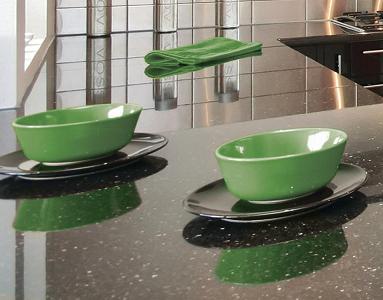
A countertop takes a lot of abuse. We put hot pans on it, cut on it, scrape and scratch at it, scour it, and spill hot liquids on it. Yet after years of abuse, your countertop is expected to look as good as ever – and mostly they do.
Today's countertop materials are truly miracles of modern engineering, evolving so rapidly that even if you've replaced a kitchen countertop in the recent past, you'll probably be surprised by the many options in materials and styles now available.
Learn about some of the common and uncommon materials available for countertop at New & Traditional Countertop Choices. (Spoiler alert: the best countertop material is not what you think!)
Rule 18 - Cooking Surface Clearance
- At least 30" (762mm) of clearance is required between the cooking surface and an unprotected/combustible surface above it. (IRC M 1901.1).
- If a microwave/vent hood combination is used above the cooking surface, then the manufacturer's specifications should be followed. (IRC M 1504.1)
Universal Design: Kitchen guideline recommendation meets Universal Design Standard.
- This rule must be coordinated with Rule 19. Most often, the item installed above a range or cooktop is a range hood or microwave/hood combination. In all cases, the minimum clearance specified by the appliance's installation instructions should be followed rather than this rule if the manufacturer's recommended minimum clearance is greater.
- If the manufacturer's clearance guidelines are less than the clearance required by this rule, the conservative, and better, approach is to use the greater clearances specified here. The exception occurs where the clearance specified here exceeds the manufacturer's maximum clearance, in which case the manufacturer's clearance specification should be used.
Rule 19 - Cooking Surface Ventilation
- Manufacturer's specifications must be followed. (IRC G 2407.1, IRC G 2447.1).
- The minimum required exhaust rate for a ducted hood is 100 cfm (2.83 cmm) and must be ducted to the outside. (IRC M 1507.3).
- Make-up air may need to be provided. Refer to local codes. (IRC G 2407.4).
Universal Design: Ventilation controls should be placed 15" (381mm) – 44" (1,118mm) above the floor, operable with minimal effort, easy to read and with minimal noise pollution.
- Operable parts should be operable with one hand and not require tight grasping, pinching or twisting of the wrist. The force required to activate operable parts should be 5 pounds (2.27 kg) maximum. (ANSI A117.1 309.4).
- Where a forward or side reach is unobstructed, the high reach should be 48" (1,219mm) maximum and the low reach should be 15" (381mm) minimum above the floor.(ANSI A117.1 308.2.1 and 308.3.1).
- Where a forward or side reach is obstructed by a 20" (508mm) to 25" (535mm) deep counter, the high reach should be 44" (1,118mm) maximum. (ANSI A117.1 308.2.2)
- Formerly it was permissible in most jurisdictions to recirculate vented air back into the kitchen. The air was drawn into the ventilating device through carbon filters, then blown back into the kitchen. Recirculation is now not allowed in most jurisdictions.
- Air must be vented through and wall or the roof to the outdoors. The earlier practice of venting into the attic is also no longer allowed due to the risk of fire.
- Generally, the specifications provided by the manufacturer of the ventilation device or system must be followed, even if they conflict with other building Code Requirements.
- Where the manufacturer's specifications are silent, then guidance is to be obtained from the applicable building Code Requirement.
- Typically make-up air is required when the capacity of the ventilation system exceeds 300 cfm. The belief is that at this capacity the house can no longer provide enough air and there is a danger of back-drafting gas appliances. Make-up air is air drawn from outside the dwelling through ducting that is installed by a mechanical contractor.
Rule 20 - Cooking Surface Safety
- Do not locate the cooking surface under an operable window.
- Window treatments above the cooking surface should not use flammable materials.
- A fire extinguisher should be located near the exit of the kitchen away from cooking equipment.
Code Requirement: National Fire Protection Association (NFPA) Guideline 10:
- Paragraph 6.1.3.1: Extinguishers shall be conspicuously located where they will be readily accessible and immediately available in the event of a fire.
- Paragraph 6.1.3.3.1: Fire extinguishers shall not be obstructed or obscured from view.
Universal Design: Place fire extinguisher between 15" (381mm) and 48" (1,219mm) off the finished floor.
ADA/ANSI Guidelines: None.
- While there are no national building code requirements, a fire extinguisher in your kitchen may be mandated by your local fire code.
- Put the fire extinguisher in plain view. If you don't like the "industrial look, hide the extinguisher in a cabinet with a conspicuous label that identifies its location.
- A kitchen fire extinguisher must be rated for Class K fires. These are fires fueled by flammable liquids and grease. Most fire extinguishers are rated for class K fires, but check to be certain.
- When you install your fire extinguisher, read the instructions for using it to fight fires.
- Stopping to read the instructions while a fire is blazing is not a good idea, but using it without reading the instructions is an even worse idea.
- Test your extinguisher at least every 6 months, more often if the manufacturer recommends a shorter interval, to make sure it is still charged and functioning. If it is not functioning, recharge or replace it.
Rule 21 - Microwave Oven Placement
Code Requirement: No national Code requirement. Check for local code requirements where you live.
Universal Design: Locate the microwave controls above 15" (381mm) and below 48" (1,219mm).
- The current guidelines do not address drawer-type microwaves. These are intended to be mounted under the countertop and are accessed from the top, not from the front. Until guidelines are developed, the best course is to carefully follow the manufacturer's instructions for placement and mounting.
- Over-the-range micro-hoods will need to follow the guideline for locating a range hood in Rules 18 and 19 above, as well as this rule.
- If there is a conflict, the guidelines of Rules 18 and 19 supersede this rule.
- The universal design guideline is a little vague when it comes to controls that have a vertical dimension, such as a keypad, but the illustrations that accompany the guideline seem to suggest that the entire pad should be above 15" (381mm) and below 48" (1,219mm) measured from the finished floor.

Planning the Perfect Pantry
Every kitchen needs a pantry. A well-stocked pantry is required for good domestic management. Whatever the size of your kitchen, it should include a convenient place to store groceries, and this critical storage requires careful thought and planning.
Whether it is a simple as a single cabinet or as elaborate as a traditional butler's pantry, to provide convenient and accessible storage, all pantries must follow a simple set of iron-clad design rules.
To learn how to design the perfect pantry, go to Pantry Perfect: The "Can't Go Wrong" Pantry Design & Organization Rules.
Rule 22 - Microwave Landing Area
Code Requirement: No national Code requirement. Check for local code requirements where you live.
Universal Design: Provide a dedicated landing area in front of or immediately adjacent to the handle side of the microwave.
Comments: Typically there is a countertop near the microwave that will serve as a landing zone.
However, if the microwave is located in a tall oven cabinet, it may be necessary to provide a landing area.
If necessary, a pull-out shelf located under the microwave will work provided it is strong and stable enough to hold a minimum of 25 lbs.
Rule 23 - Oven Landing Area
- Include at least a 15" (381mm) landing area next to or above the oven.
- At least a 15" (381mm) landing area that is not more than 48" (1,219mm) across from the oven is acceptable if the appliance does not open into a walkway.
Code Requirement: No national Code requirement. Check for local code requirements where you live.
Universal Design: See ADA/ANSI Guidelines.
ADA/ANSI Guidelines: For side-opening ovens, the door latch side should be next to a countertop (ANSI A 117.1 804.6.5.1)
Comments: If an oven in a range has to share the landing zone on one side of the range with a microwave vent over the range, one interpretation of Rule 24 (see below) is that the combined landing zone has to be 27" (686mm) or larger.
This is our recommendation.
Rule 24 - Combining Landing Areas
Guideline: If two landing areas are adjacent to one another, determine a new minimum for the two adjoining spaces by taking the larger of the two landing area requirements and adding 12" (305mm).
Code Requirement: No national Code requirement. Check for local code requirements where you live.
Universal Design: Kitchen guideline recommendation meets Universal Design Standard.
Comments: If an oven in a range has to share the landing zone on one side of the range with a microwave vent over the range, one interpretation of Rule 24 (see below) is that the combined landing zone has to be 27" (686mm) or larger.
This is our recommendation.
Rule 25 - Countertop Space
Notes: Built-in appliance garages extending to the countertop can be counted towards the total countertop frontage recommendation, but they may interfere with the landing areas.
Code Requirement: No national Code requirement. Check for local code requirements where you live.
Universal Design: At least two work-counter heights should be offered in the kitchen, with one 28" to 36" (711mm to 914mm) above the finished floor and the other 36" to 45" (914mm to 1,143mm) above the finished floor.
- Any countertop at least 24" (610mm) deep can be counted. Almost all standard countertops meet this requirement – most are 25" (635mm) deep.
- If a countertop is shallower than 24" (610mm), then, according to this Rule, it does not count toward the 158" (3962mm) of countertop frontage.
- However, in remodeling older kitchens, shallow countertops are often required to meet the 42" and 48" (1,219mm) work-aisle requirements of Rule 6. This is where the designer's experience and good judgment comes into play in making the trade-off.
- We generally count any countertop at least 21" (533mm) deep but less than 24" (610mm) as 3/4ths. So, 4' (914mm) of 21" countertop would count as 3' of countertop frontage.
- The countertop is measured along its front edge, so inside corners do not count toward the minimum counter space.
- The guideline allows counting the countertop in front of appliance garages and other similar storage items that rest on the countertop, even though this reduces the usable countertop area to as little as 13" (330mm). We suggest calculating this section of countertop to be no more than one-half.
- The guideline is not clear how island countertops are to be counted. Do you count just one side or both sides? If the countertop is accessible from both sides and is at least 24" (610mm) deep, we count both sides, but not the ends.
Rule 26 - Countertop Corners
Code Requirement: No national Code requirement. Check for local code requirements where you live.
Universal Design: Kitchen guideline recommendation meets Universal Design Standard.
- Although the guideline does not distinguish between inside and outside corners, it is clear that the recommendation applies only to outside corners.
- The guideline does not provide a minimum radius for rounded corners. On a 1" (25mm) overhang countertop – the typical overhang – the largest radius possible is about 2" (50mm).
- Corners may be clipped (the more common term is "chamfered") or rounded ("filleted"). Both options meet the guideline.
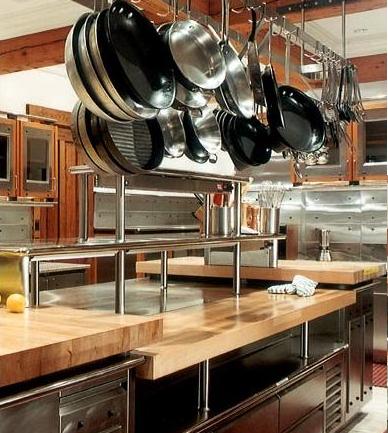
What We Have Learned From Commercial Kitchens
Often the difference between a successful kitchen that is both beautiful and easy to work in is the design of the kitchen's storage. Cabinetry layout and configuration is an important part of the storage design but it is not the whole story.
We have found that the best model for successful storage design is the commercial kitchen. Restaurant kitchens are designed for maximum efficiency and ease of preparing hundreds of appetizing meals in a very short time. Not every feature of a commercial installation works in a home kitchen, but many do.
To discover the secrets of commercial kitchens, go to Mise-en-Place: What We Can Learn About Kitchen Design from Commercial Kitchens.
Rule 27 - Storage
| Distribution of Shelf & Drawer Space | |||
|---|---|---|---|
| Kitchen Size | |||
| Small | Medium | Large | |
|
Wall Base Drawer Pantry Misc |
300" 520" 360" 180" 40" |
360" 615" 400" 230" 95" |
360" 660" 525" 310" 145" |
| * Storage more than 84" (213.36cm) above the floor is considered miscellaneous storage. | |||
- 1400" (3556cm) for a small kitchen (less than 150 sq. ft./13.94 sq. meters);
- 1700" (4318cm) for a medium kitchen (151 to 350 sq. ft./14.02 to 32.52 sq. meters); and
- 2000" (5080cm) for a large kitchen (greater than 350 sq. ft./32.52 sq. meters).
Code Requirement: No national Code requirement. Check for local code requirements where you live.
Universal Design: Plan storage of frequently used items 15" (381mm) to 48" (1,219mm) above the floor.
- Where a forward or side reach is unobstructed, the high reach should be 48" (1,219mm) maximum and the low reach should be 15" (381mm) minimum above the floor. (ANSI A117.1 308.2.1 and 308.3.1)
- Where a 20" to 25" (508mm to 635mm) deep counter obstructs a forward or side reach, the high reach should be 44" (1,117mm) maximum. (ANSI A117.1 308.2.2) (See Rule 11, Image 11A for an illustration.)
- Shelf and drawer frontage is determined by multiplying the cabinet size by the number and depth of the shelves or drawers in the cabinet, using the following formula: Cabinet width in inches x number of shelves and drawers x cabinet depth in feet (or fraction thereof) = shelf and drawer frontage.
- The recommended distribution for the shelf and drawer frontage in inches is shown in the table at left. The totals for wall, base, drawer, and, pantry shelf/ drawer frontage can be adjusted upward or downward as long as the recommended total does not decrease.
- Do not apply more than the recommended amount of storage in the miscellaneous category to meet the total frontage recommendation.
- Storage areas that are more than 84" (2,438mm) above the floor must be counted in the miscellaneous category.
- Storage/organizing items can enhance the functional capacity of wall, base, drawer, and pantry storage and should be selected to meet user needs.
Comments: This design guideline is badly out of date. The whole notion of minimum shelf and drawer frontage is an attempt to quantify functionality that is not readily quantifiable.
While the calculation may serve the need to have some math problems on the various NKBA certification examinations, it has little real-world utility.
- it does not take into account the trend over the past twenty years of moving away from shelving in lower cabinets and toward drawers;
- it does not realistically distinguish between accessible and inaccessible storage, and
- it completely ignores the iron rules of storage.
- Store each item where it is first used.
- Size storage to the things being stored.
- Store items in a single layer with no item hidden behind or underneath another.
The only nod to storage accessibility is "miscellaneous" storage which is defined as any storage above 84" (2134.4mm) from the floor. It is calculated as full frontage, but a strict limit is placed on how much of this storage a kitchen may have. A better approach is to weigh the value of storage based on its accessibility.
For example, we treat the following as inaccessible storage to be counted in formulas as having 1/2 the value of accessible storage:
- The back of a base cabinet shelf behind the first 12",
- The part of any upper cabinet or tall cabinet shelf behind the first 15" (381mm), and
- Any storage more than 78" from the floor.
To illustrate how differentiating between useful and inaccessible storage makes cabinet storage calculations more accurate, consider the following comparison:
Guideline calculations treat the following two storage examples as having the same frontage:
- A 24 inch-deep base cabinet with two shelves has the following frontage: 24" x 2' x 2 = 96inches.
- A 24 inch-deep base cabinet with two drawers has the same frontage: 24" x 2' x 2 = 96 inches.
But all of the drawer space is accessible storage (to reach the back 12", just pull the drawer out) while only the front 12" of the shelves in base cabinets is useful storage, the back 12" is inaccessible.
Treating the two storage modalities as if they provided the same amount of useful storage is misleading. The drawers are more useful storage and their higher utility should be accounted for in calculating minimum frontage.
In our calculations, we score inaccessible storage at only 1/2 the value of accessible storage.
The formula for the accessible part of the shelf remains the same: (width in inches) × (depth in feet) × (number of shelves), but it applies to just the front 12" of the shelf. So using the above example, the frontage of the accessible part of the base cabinet shelves is
24" × 1' × 2 shelves = 48" (1,219mm) of frontage.
The revised formula for the back 12" of a shelf is (width in inches) × (depth in feet) × (number of shelves) / 2. This gives the back half of the shelf a reduced frontage of 24" (610mm) because the back of the shelf is only half as useful as the front of the shelf due to its inaccessibility. The calculation
24" × 1' × 2 shelves / 2 = 24" of frontage.
The total frontage for the base cabinet with two shelves is the sum of these two calculations:
48" (accessible storage) + 24" (inaccessible storage) = 72" (1,829mm) of frontage.
The base cabinet with drawers retains its original frontage of 96" (2,438mm).
Now the comparison of frontage scores clearly shows the drawer cabinet to have 25% more useful storage than the shelf cabinet which is much closer to the real world of storage.
Rule 28 - Storage at Main Sink
Guideline: Of the total recommended wall, base, drawer and pantry shelf and drawer frontage, the following should be located within 72" (1,829mm) of the centerline of the main sink:
- at least 400" (1,016cm) for a small kitchen (less than 150 sq. ft./13.94 sq. meters);
- at least 480" (1,219cm) for a medium kitchen (150-350 sq. ft./14.02 to 32.52 sq. meters);
- at least 560" (1,422cm) for a large kitchen (more than 350 sq. ft./32.52 sq. meters).
Code Requirement: No national Code requirement. Check for local code requirements where you live.
Universal Design: Plan storage of frequently used items 15" (381mm) to 48" (1,219mm) above the floor.
Comment: this guideline is not difficult to meet. Any properly designed kitchen is going to cluster storage around the three main task centers: Food preparation, Cooking, and Cleanup. The only strange aspect of this guideline is that the same attention is not paid to storage at the prep and cooking centers.
Rule 29 - Corner Cabinet Storage
Notes: This guideline does not apply if there are no corner cabinets.
Code Requirement: No national Code requirement. Check for local code requirements where you live.
Universal Design: Kitchen guideline recommendation meets Universal Design Standard.
Comments: Corner cabinets are not required in a kitchen. The guideline seems to imply that they are. The guideline merely recommends that if corner cabinets are included, they should contain usable storage.
We do our utmost to avoid using corner cabinets simply because at their very best, they provide storage that is of marginal utility.
For much more information on making the best use of corner cabinet space, consider …
Efficient, Accessible, Ergonomic Storage
These rules barely scratch the surface of effective, accessible storage design. Storage is affected by much more than just the gross number of cabinets or how corner-cabinet storage is handled. Cabinet design and configuration, storage location in relation to task centers, and any physical limitations you may have (or will have in the future) all have a major impact on storage design.

- Body Friendly Design: The Principles of Ergonomic Kitchen Design
- Ergonomic kitchen design optimizes workflow, reduces physical strain, and boosts efficiency by tailoring the kitchen environment to the user's body, creating a safer, more enjoyable working environment.
- Pantry Perfect – The "Can't Go Wrong" Pantry Design & Organization Rules
- Whether it is a simple as a single cabinet or as elaborate as a traditional butler's pantry, to provide convenient and accessible storage, all pantries must follow a simple set of iron-clad design rules that are adaptable to all kitchen storage.
- Mise-en-Place: What We Can Learn About Kitchen Design from Commercial Kitchens
- The best model for successful storage design is the commercial kitchen. Restaurant kitchens are designed for maximum efficiency and ease of preparing hundreds of appetizing meals in a very short time. Efficient storage is their lifeblood.
Rule 30 - Electrical Receptacles
Universal Design: Lighting controls should be placed 15" to 44" (381mm to 1,118mm) above the floor, operable with minimal effort, easy to read and with minimal noise pollution.
- Operable parts should be operable with one hand and not require tight grasping, pinching or twisting of the wrist. The force required to activate operable parts should be 5 pounds (2.27 kg) maximum. (ANSI A117.1 309.4).
- Where a forward or side reach is unobstructed, the high reach should be 48" (1,219mm) maximum and the low reach should be 15" (381mm) minimum above the floor. (ANSI A117.1 308.2.1 and 308.3.1).
- Where a 20" to 25" (508mm to 635mm) deep counter obstructs a forward or side reach, the high reach should be 44" (1,117mm) maximum. (ANSI A117.1 308.2.2) (See Rule 11, Image 11A for an illustration.)
Comments: GFCI and AFCI outlets protect against electrical hazaards by shutting the electricity off when they detect a potential problem in the flow of electricity.
hey detect two kinds of electrical faults. A GFCI measures the amount of electricity going out against the amount returbing. If a variance it detected, the circuit assumes a short circuit such as would result from accidentlly dropping an electric mixer into sink full of water, and instantly disables the circuit.
An AFCI detects arcs within an electrical circuit. An arc occurs when tlectricity jumps between the positive and negative or neutral wires inside a cable or junction box. Arcs can be as hot as 10,000°F (5,537.8°C) and can cause house fires. They are uncommon in new housing, but become more of a risk as the system ages. Without an AFCI, they are virtulally undetectable, occurng inside walls where they cannot be seen.
An often less expensive option than converting all of a kitchen's electrical outlets to AFCI/GFCI is to install what is called a dual function (AFCI+GFCI) breaker in the electrical service panel to protect the entire circuit.
For more information on the structural components of the kitchen; the piping, heating and cooling, electricity and lighting, see Behind the Scenes - The Hidden Kitchen.
Rule 31 - Lighting
- At least one wall-switch-controlled light must be provided. Switch must be placed at the entrance. (IRC E 3803.2).
- Window/skylight area, equal to at least 8% of the total square footage of the kitchen, or a total living space which includes a kitchen, is required. (IRC R 303.1, IRC R 303.2)
Universal Design: Lighting should be from multiple sources and adjustable
- Operable parts should be operable with one hand and not require tight grasping, pinching, or twisting of the wrist. The force required to activate operable parts should be 5 pounds maximum. (ANSI A117.1 309.4).
- Where a forward or side reach is unobstructed, the high reach should be 48" (1,219mm) maximum and the low reach should be 15" (381mm) minimum above the floor. (ANSI A117.1 308.2.1 and 308.3.1).
- Where a 20" to 25" (508mm to 635mm) deep counter obstructs a forward or side reach, the high reach should be 44" (1,117mm) maximum. (ANSI A117.1 308.2.2) (See Rule 11, Image 11A for an illustration.)
The code requirement that a light switch should be placed at "the entrance" to a kitchen is often interpreted by code inspectors to require a switch at each entrance. The height and position of switches are governed in most jurisdictions by the National Electrical Code.
All About Kitchen Lighting

Because it typically opens for business before dawn and closes long after sunset, a kitchen uses a lot of energy for lighting. That makes this room an important place to use efficient lighting. While remodeling your kitchen, you have the perfect opportunity to create an effective but also highly efficient lighting system.
Designing a lighting system that provides just the right light yet uses very little electricity is the goal of lighting design. It is not a trivial process. And it requires an intimate understanding of how light works.
To learn about light and lighting design, go to Designing Efficient & Effective Kitchen Lighting.
Pantry Design Rules
Every kitchen needs a pantry. Whatever the size or shape of your kitchen, it should include a convenient place to store groceries, and this critical storage requires careful thought and planning. It should be large enough to hold at least a week's worth of groceries, and close enough to the food preparation…(Continues)
Rev. 05/14/26